Table Of Contents
House Cleaning Service Pricing: 2026 Cost Calculator & Rates
You're ready to hire a cleaner but the pricing feels like a mystery. Should you pay by the hour or lock in a flat rate? Will your 2,000-square-foot home cost $175 or $450? How much should you budget for a deep clean versus standard maintenance? The answer depends on factors you might not even know to consider yet.
This guide breaks down exactly how cleaners price their services in 2026. You'll see current hourly rates, flat fees, and per-square-foot costs based on real market data from across the country. We'll show you a straightforward way to calculate your budget before you start calling companies.
We walk you through five clear steps to understand and estimate cleaning costs. You'll learn what drives prices up or down, how to choose the right pricing model for your home, what your location and home size actually mean for your bill, and what questions to ask when comparing quotes. By the end, you'll know what to expect and how to find a cleaner who delivers quality service within your budget.
What affects house cleaning service pricing
House cleaning service pricing depends on several concrete factors that you can identify before you contact any company. Your home's size and the type of cleaning you need form the foundation of most quotes. Cleaners also consider your location, how often you want service, and whether you have special requirements like pet hair removal or eco-friendly products. Understanding these variables helps you predict costs and avoid surprise fees.
Home size and square footage
Cleaners base most estimates on how much space they need to cover. A 1,000-square-foot apartment takes less time and fewer supplies than a 3,000-square-foot house, so you'll pay more for larger spaces. Square footage directly impacts your final bill whether a company charges hourly or uses a flat rate. Most cleaners also count bedrooms and bathrooms separately since these rooms require more detailed work than hallways or living areas.
Type of cleaning service
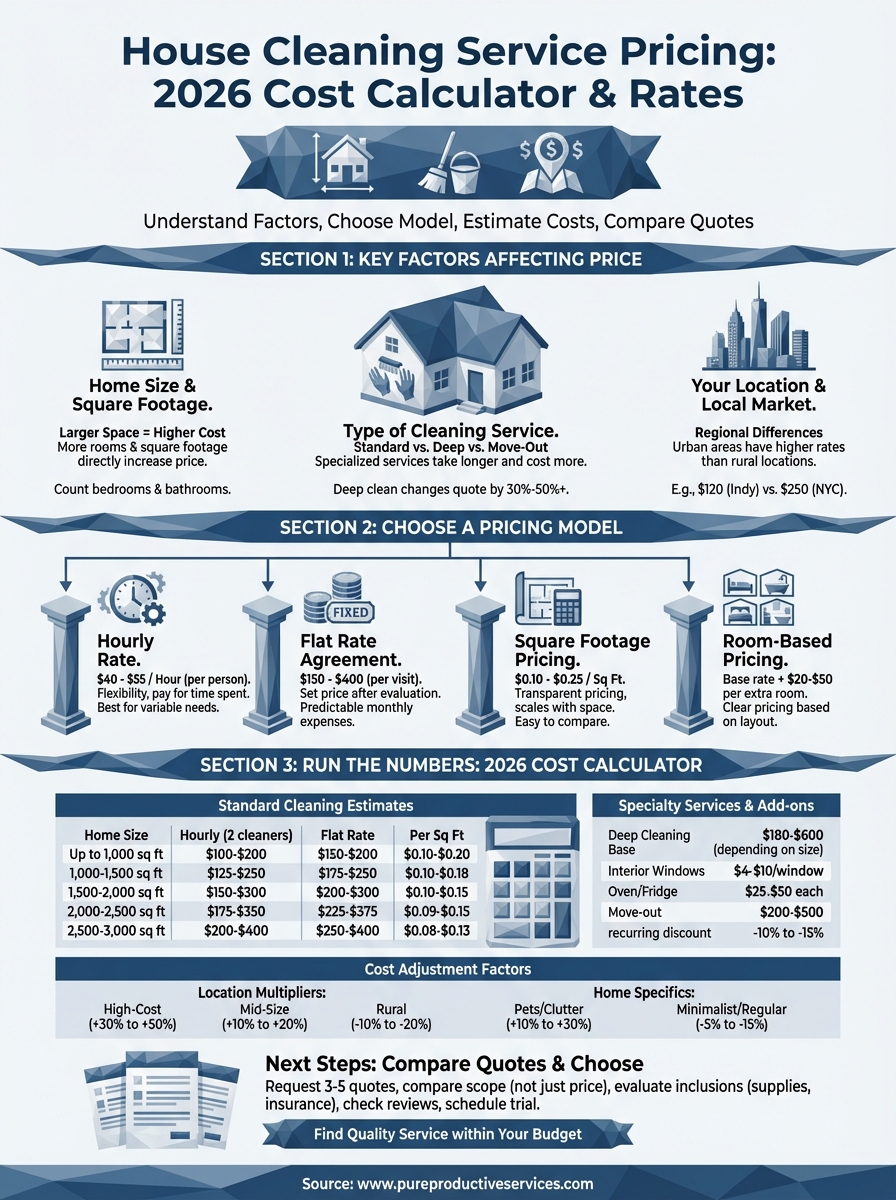
Standard maintenance cleaning costs less than specialized deep cleaning or move-out services. Regular weekly or biweekly visits keep your home in good shape with basic dusting, vacuuming, and surface wiping. Deep cleaning tackles built-up grime in hard-to-reach areas, scrubs grout, cleans inside appliances, and takes significantly longer. Move-out cleaning, post-construction cleanup, and same-day emergency service all command premium rates because they involve more intensive labor or scheduling flexibility.
The type of service you choose can change your quote by 30% to 50% or more.
Your location and local market
Where you live changes what you pay for the same service. Cleaners in San Francisco or New York City charge more than those in smaller markets because their operating costs, insurance, and labor expenses run higher. Regional differences in cost of living mean a standard cleaning might cost $120 in Indianapolis but $250 in Manhattan for comparable homes. Urban areas typically see higher rates than suburban or rural locations within the same state.
Step 1. Define your cleaning needs and goals
Before you can accurately compare house cleaning service pricing, you need to clarify exactly what you want cleaned and how often you need service. This step prevents confusion during quotes and ensures cleaners give you accurate estimates instead of ballpark figures that change later. Write down your specific requirements before contacting any companies so you can provide consistent information to each one.
List what rooms need cleaning
Start by counting every room that requires attention. Walk through your home with a notepad and record each bedroom, bathroom, kitchen, living area, dining room, and any other spaces you want included. Note the square footage of your entire home if you know it, or measure key rooms if you don't. Identify which bathrooms need full service versus just basic tidying, and mark any rooms that stay closed or rarely get used.
Create a simple checklist like this for each quote request:
Decide on cleaning frequency
Determine whether you need one-time service or recurring visits. Weekly cleaning costs more per month than monthly service but typically offers lower per-visit rates. Biweekly (every two weeks) schedules provide a middle option that many homeowners choose for maintenance cleaning. One-time deep cleans work well before events or after renovations but usually cost 30% to 50% more than standard cleanings.
Identify any special requirements
List any add-on services or special requests you need beyond basic cleaning. These might include interior window washing, refrigerator cleaning, oven scrubbing, laundry, inside cabinet wiping, or pet hair removal. Specify if you require eco-friendly products, have pets that need accommodation, or need cleaning during specific hours. Note any areas that need extra attention like high-traffic zones or rooms with young children.
Defining these details upfront helps you get accurate quotes and avoids miscommunication about what's included in your service.
Step 2. Choose a pricing model that fits you
Cleaners use four main pricing structures to calculate your house cleaning service pricing, and each model works better for certain situations. You'll encounter hourly rates, flat fees, per-square-foot charges, or per-room pricing when you request quotes. Understanding how each model works helps you predict your costs and choose the approach that gives you the most value for your specific home and cleaning needs.
Hourly rate structure
Most cleaners charge $40 to $55 per hour per person on their crew. This model works well when you want flexibility to add or remove tasks between visits, or when your home's condition varies significantly from week to week. You pay only for time spent cleaning, which benefits you if your home stays relatively tidy between appointments. However, hourly pricing can become unpredictable if a new cleaner takes longer than usual or if you have an especially messy week.
Ask these questions when considering hourly pricing:
Flat rate agreements
Flat rates range from $150 to $400 depending on your home size and service type. Companies that use this model quote one set price after evaluating your space, regardless of how long the cleaning takes. This structure gives you predictable monthly expenses and removes uncertainty about your bill. You benefit when your home requires consistent effort each visit, you want to budget precisely, or you schedule recurring service on a regular schedule.
Flat rates reward efficiency and give you peace of mind about your exact costs before each visit.
Square footage and room-based pricing
Some cleaners charge $0.10 to $0.25 per square foot or set prices based on bedroom and bathroom counts. A 2,000-square-foot home at $0.15 per square foot costs $300 per visit. Per-room pricing typically starts with a base rate for one bedroom and one bathroom, then adds $20 to $40 for each additional bedroom and $30 to $50 for extra bathrooms. These models work best when your home's layout matches standard cleaning patterns and you want transparent pricing that scales with your space. Choose these options if you need to easily compare quotes across multiple companies or if your home size clearly defines your cleaning requirements.
Step 3. Run the numbers with 2026 cost ranges
You now need to apply current market rates to your specific cleaning requirements to estimate your actual costs. This step transforms your cleaning list from Step 1 into a concrete budget range you can use to evaluate quotes. We'll walk you through standard rates, specialty service costs, and a simple calculation method that shows you what to expect before you contact any companies.
Standard cleaning cost estimates
Standard cleaning includes routine maintenance tasks like dusting, vacuuming, mopping, bathroom sanitizing, and kitchen surface wiping. Most companies price these services using one of the models we covered earlier, but national averages give you a starting point for house cleaning service pricing. Use this table to estimate costs based on your home size:
Home SizeHourly Rate (2 cleaners)Flat Rate Per VisitPer Square FootUp to 1,000 sq ft$100-$200 (2 hours)$150-$200$0.10-$0.201,000-1,500 sq ft$125-$250 (2.5 hours)$175-$250$0.10-$0.181,500-2,000 sq ft$150-$300 (3 hours)$200-$300$0.10-$0.152,000-2,500 sq ft$175-$350 (3.5 hours)$225-$375$0.09-$0.152,500-3,000 sq ft$200-$400 (4 hours)$250-$400$0.08-$0.13
Recurring service typically costs 10% to 15% less per visit than one-time cleanings because your home stays cleaner between appointments. Weekly service offers the deepest discounts, followed by biweekly schedules, while monthly visits usually match one-time rates.
Deep cleaning and specialty service costs
Deep cleaning tackles neglected areas and requires significantly more time than standard maintenance. Expect to pay 30% to 50% more for deep cleaning services that include baseboard scrubbing, inside cabinet wiping, appliance interiors, grout cleaning, and detailed dusting of ceiling fans and fixtures. Here are typical 2026 rates for common specialty services:
Deep cleaning base costs:
Common add-on services:
Move-out cleaning ranges from $200 to $500 depending on home size and condition, while post-construction cleanup typically costs $300 to $800 for residential properties. Emergency or same-day service usually adds a 20% to 40% premium to standard rates.
Calculate your total by starting with your base cleaning cost, then adding any specialty services you identified in Step 1.
Calculate your estimated total
Create your budget estimate using this simple template. Start with the base cost that matches your home size and cleaning type, then add any extras:
$_____ (from tables above)
$_____
$_____
$_____
- $_____
Here's a concrete example: You have a 2,000-square-foot home with 3 bedrooms and 2 bathrooms. You want standard biweekly cleaning plus monthly interior window cleaning (12 windows) and quarterly oven cleaning.
Your calculation:
This method gives you a realistic budget range before you start comparing actual quotes. Adjust the numbers based on whether local rates in your area run higher or lower than national averages, which we cover in the next step.
Step 4. Factor in your location and home details
Your base estimates from Step 3 need adjustment based on where you live and your home's specific characteristics. House cleaning service pricing varies significantly by region, and certain features of your property can push costs up or down by 20% to 40% from the national averages. This step shows you how to refine your budget using local market data and home-specific factors that cleaners consider when finalizing quotes.
Regional cost adjustments
Cleaners in major metropolitan areas charge substantially more than those serving smaller cities or rural communities. The difference stems from higher labor costs, insurance premiums, and operating expenses in expensive markets. Your location directly impacts your final rate regardless of your home's size or the services you need.

Use these regional multipliers to adjust your Step 3 estimates:
Region TypeCost AdjustmentExample CitiesHigh-cost metros+30% to +50%San Francisco, New York City, Boston, SeattleMid-size cities+10% to +20%Philadelphia, Denver, Portland, AustinSmall cities/suburbsBaseline (0%)Smaller metro suburbs, regional centersRural areas-10% to -20%Counties outside metro areas
If your Step 3 estimate showed $250 for a standard cleaning and you live in Philadelphia, multiply by 1.15 (adding 15%) to get $287.50 as your adjusted estimate. High-cost metros like Manhattan might push that same base $250 to $325 or higher.
Home-specific multipliers
Certain characteristics of your property change how much time and effort cleaners need to complete the job. These factors can increase or decrease your costs beyond the base square footage rates. You should expect adjustments when your home includes any of these conditions:
Cost increases (10% to 30% more):
Cost decreases (5% to 15% less):
Adjusting your estimate for both location and home-specific factors gives you the most accurate budget before requesting formal quotes.
Calculate your final adjusted estimate by taking your Step 3 total, applying your regional multiplier, then adding or subtracting for home-specific factors. A $250 base estimate in Philadelphia with two shedding dogs becomes: $250 × 1.15 = $287.50, then +15% for pets = $330.63 as your refined budget target.
Step 5. Compare quotes and choose a provider
You've calculated your budget and know what to expect, so now you need to collect actual quotes from cleaning companies in your area. This step transforms your estimates into real house cleaning service pricing that you can compare side-by-side. Request quotes from at least three providers to see the full range of what's available, then evaluate each option based on specific criteria beyond just the bottom-line price.
Request quotes from at least three companies
Contact three to five cleaning services and provide each one with identical information about your home and needs. Give them your square footage, room counts, cleaning frequency, and any add-on services you identified in Step 1. Ask for written quotes that break down exactly what's included rather than accepting verbal estimates over the phone. Request that each company specify whether they charge hourly, use flat rates, or price per square foot so you can make direct comparisons.
Evaluate what each quote includes
Compare the scope of services in each quote rather than focusing only on price. One company quoting $225 might include window cleaning and inside-refrigerator service, while another at $195 covers only basic tasks and charges extra for those items. Check whether the quote includes cleaning supplies and equipment, or if you need to provide them. Verify that the company carries liability insurance and bonds its employees, and confirm whether they background-check their staff. Look for satisfaction guarantees or policies about returning to fix missed areas.
The lowest quote often excludes services that higher-priced competitors include as standard, so read the fine print carefully.
Make your final decision
Choose the provider that offers the best value for your specific needs rather than automatically picking the cheapest option. Factor in the company's experience, online reviews, and responsiveness during your initial contact. Schedule a trial cleaning if the company offers one, so you can evaluate their work quality before committing to a long-term contract. Confirm the payment terms, cancellation policy, and whether they offer any discounts for recurring service before you sign an agreement.
Next steps
You now understand how house cleaning service pricing works in 2026 and what you should expect to pay based on your home's size, location, and cleaning needs. Your budget estimate from Step 3, adjusted for regional costs and home-specific factors in Step 4, gives you a realistic range to use when comparing actual quotes. You've also learned which questions to ask providers and how to evaluate quotes beyond just the bottom-line price.
Request written quotes from three to five companies in your area using the details you defined in Step 1. Compare what each quote includes, check for insurance and bonding, and read online reviews before making your decision. If you're in the Philadelphia area and want a professional team with 13 years of experience, certified staff, and flexible scheduling options, get a quote from Pure Productive Services for both commercial and residential cleaning that fits your budget and delivers consistent results every visit.

