
Table Of Contents
Medical Office Cleaning Services: What They Include & Cost
Medical office cleaning services are specialized cleaning solutions designed for healthcare facilities like doctor's offices, dental practices, urgent care centers, and outpatient clinics. Unlike standard commercial cleaning, these services follow strict healthcare protocols and use hospital-grade disinfectants to eliminate pathogens and meet regulatory standards. Your medical facility needs more than just a clean appearance. You need a service that understands OSHA requirements, bloodborne pathogen protocols, and CDC guidelines.
This guide breaks down everything you need to know about medical office cleaning services. You'll learn what services are included, how much they typically cost, what questions to ask providers, and how to choose a company that meets healthcare compliance standards. Whether you manage a small practice or oversee multiple medical locations, this information helps you make an informed hiring decision.
Why medical office cleaning services matter
Medical facilities face unique cleaning challenges that go beyond typical office spaces. Your waiting rooms, exam rooms, and treatment areas host sick patients daily, creating high-risk environments for disease transmission. Standard cleaning methods don't eliminate dangerous pathogens like MRSA, C. difficile, or hepatitis viruses that can survive on surfaces for hours or days.
Patient safety and infection control
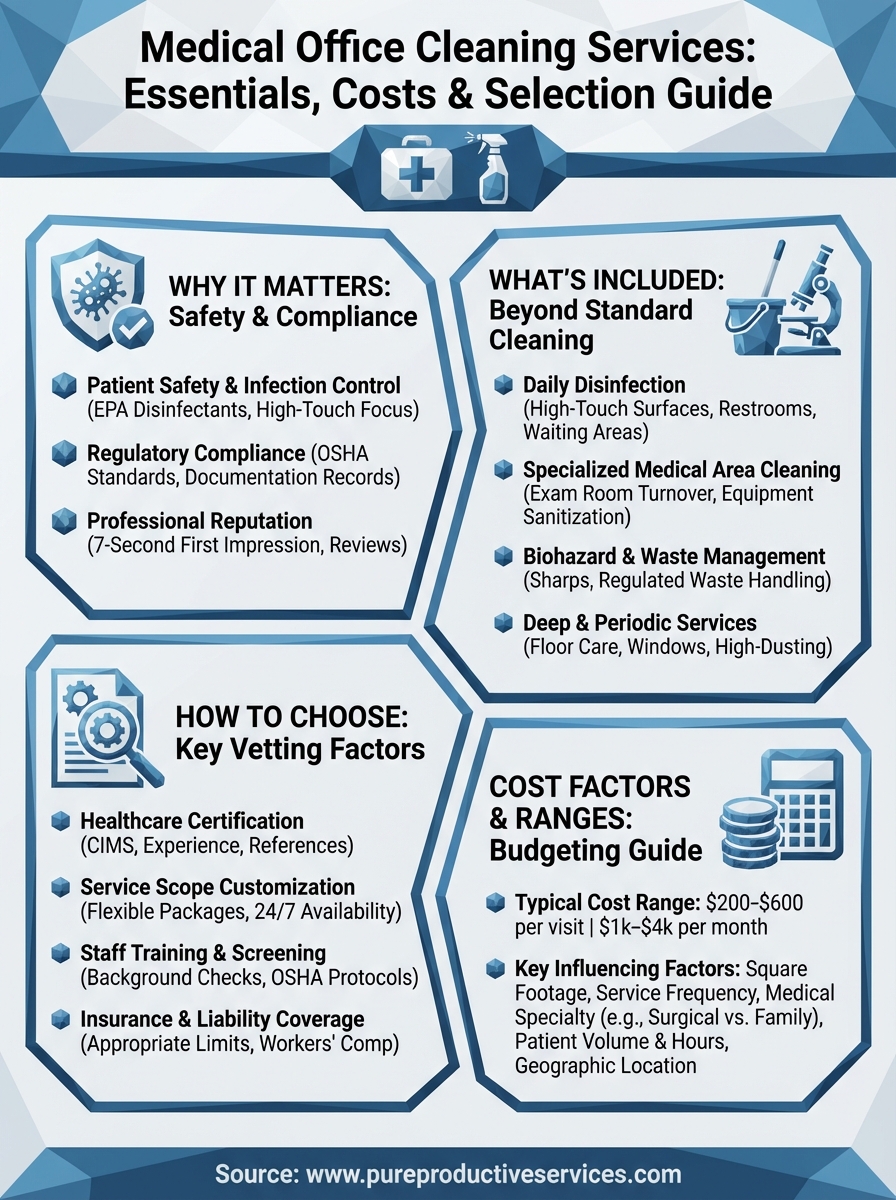
Healthcare-associated infections affect one in 31 hospital patients on any given day, according to the CDC. Your medical office cleaning services must use EPA-registered disinfectants with specific contact times to kill these pathogens effectively. Professional medical cleaners follow strict protocols for high-touch surfaces like door handles, light switches, and medical equipment that patients and staff contact repeatedly throughout the day.
Proper disinfection protocols reduce cross-contamination risks and protect both your patients and staff from preventable infections.
Regulatory compliance requirements
OSHA regulations require medical facilities to maintain specific cleaning and disinfection standards, particularly for areas with potential bloodborne pathogen exposure. You face potential fines and liability issues if inspectors find non-compliance during audits. Professional medical office cleaners understand these requirements and document their cleaning procedures to help you maintain compliance records for regulatory inspections.
Professional reputation impact
Patients judge your practice within seven seconds of entering your facility, and visible cleanliness plays a major role in their assessment. Your online reviews often mention facility cleanliness, directly affecting your ability to attract new patients. A professional cleaning service maintains consistent standards across all areas of your practice, from the reception desk to restrooms, ensuring every patient encounter starts with a positive impression of your commitment to their health and safety.
How to choose medical office cleaning services
Selecting the right medical office cleaning services requires evaluating specific factors that don't matter as much for standard commercial cleaning. You need a provider who understands healthcare environments and can demonstrate compliance expertise beyond basic janitorial work. Your decision affects patient safety, regulatory standing, and your practice's reputation, so taking time to assess potential providers pays off in the long term.
Healthcare certification and compliance experience
Your cleaning provider should hold certifications specific to healthcare environments, such as CIMS (Cleaning Industry Management Standard) certification with healthcare specialization or equivalent credentials. Ask how long they've served medical facilities and request client references from similar practices. Providers experienced in medical settings understand the difference between cleaning and disinfecting, know proper contact times for various pathogens, and follow specific protocols for biohazard waste handling. They also maintain detailed documentation that supports your facility's compliance during inspections.
Service scope and customization options
Medical facilities have different cleaning needs than typical offices, and your provider must offer flexible service packages that address your specific requirements. You need daily disinfection of high-touch surfaces, specialized cleaning for exam rooms between patients, and deep cleaning protocols for treatment areas. Some providers offer 24/7 availability for emergency cleaning situations, such as biohazard spills or infectious disease exposures. Ask whether they can customize their services based on your patient volume, specialty type, and operating hours. Dental offices need different protocols than family practices, and surgical centers require more intensive cleaning than basic examination facilities.
Your medical office requires cleaning protocols that adapt to your specific specialty, patient volume, and regulatory requirements rather than one-size-fits-all solutions.
Staff training and background screening
The cleaners entering your facility access sensitive patient areas and potentially confidential information. Verify that the company conducts comprehensive background checks, drug testing, and employment verification for all staff members. Your provider should offer documented training programs covering OSHA bloodborne pathogen standards, proper PPE usage, and correct disinfectant application techniques. Ask about their staff turnover rates and whether you'll see consistent team members who become familiar with your facility's specific needs and layout.
Insurance coverage and liability protection
Medical facilities face higher liability risks than standard commercial properties, making adequate insurance coverage non-negotiable. Your cleaning provider needs both general liability and workers' compensation insurance with coverage limits appropriate for healthcare environments. Request current certificates of insurance and verify coverage directly with their insurance carrier. This protection shields you from liability if a cleaner injures themselves in your facility or causes damage to expensive medical equipment during cleaning procedures.
What medical office cleaning services include
Medical office cleaning services extend far beyond basic vacuuming and trash removal. Professional healthcare cleaners provide specialized disinfection protocols, biohazard waste handling, and surface-specific cleaning that standard commercial services don't offer. Your provider should deliver comprehensive cleaning that addresses both visible cleanliness and invisible pathogen elimination. The specific services you receive depend on your facility type, patient volume, and specialty requirements, but certain core elements apply across all medical environments.
Daily cleaning and disinfection protocols
Your medical office cleaning services should include daily disinfection of high-touch surfaces using EPA-registered disinfectants with appropriate contact times for healthcare pathogens. Cleaners target door handles, light switches, countertops, armrests, and reception desk surfaces that patients and staff contact repeatedly throughout the day. They also sanitize waiting room furniture, magazines (or replace them), and children's play areas if applicable. Restroom cleaning goes beyond standard commercial protocols, with hospital-grade disinfectants applied to all surfaces, fixtures, and floors. Your cleaning team restocks supplies, empties trash receptacles, and removes soiled linens for proper laundering according to healthcare standards.
Specialized medical area cleaning
Exam rooms require room turnover cleaning between patients, which includes disinfecting examination tables, counters, sinks, and any equipment the patient contacted. Your cleaning provider should follow specific protocols for treatment rooms where invasive procedures occur, using appropriate disinfectants and allowing proper dwell times. They clean diagnostic equipment exteriors, computer keyboards, phones, and tablets according to manufacturer guidelines. Laboratory areas need specialized attention for specimen handling surfaces, and dental practices require unique protocols for operatories, including dental chair cleaning and cuspidor sanitization. Surgical or procedure rooms demand the most intensive cleaning protocols, often requiring terminal cleaning procedures after each use.
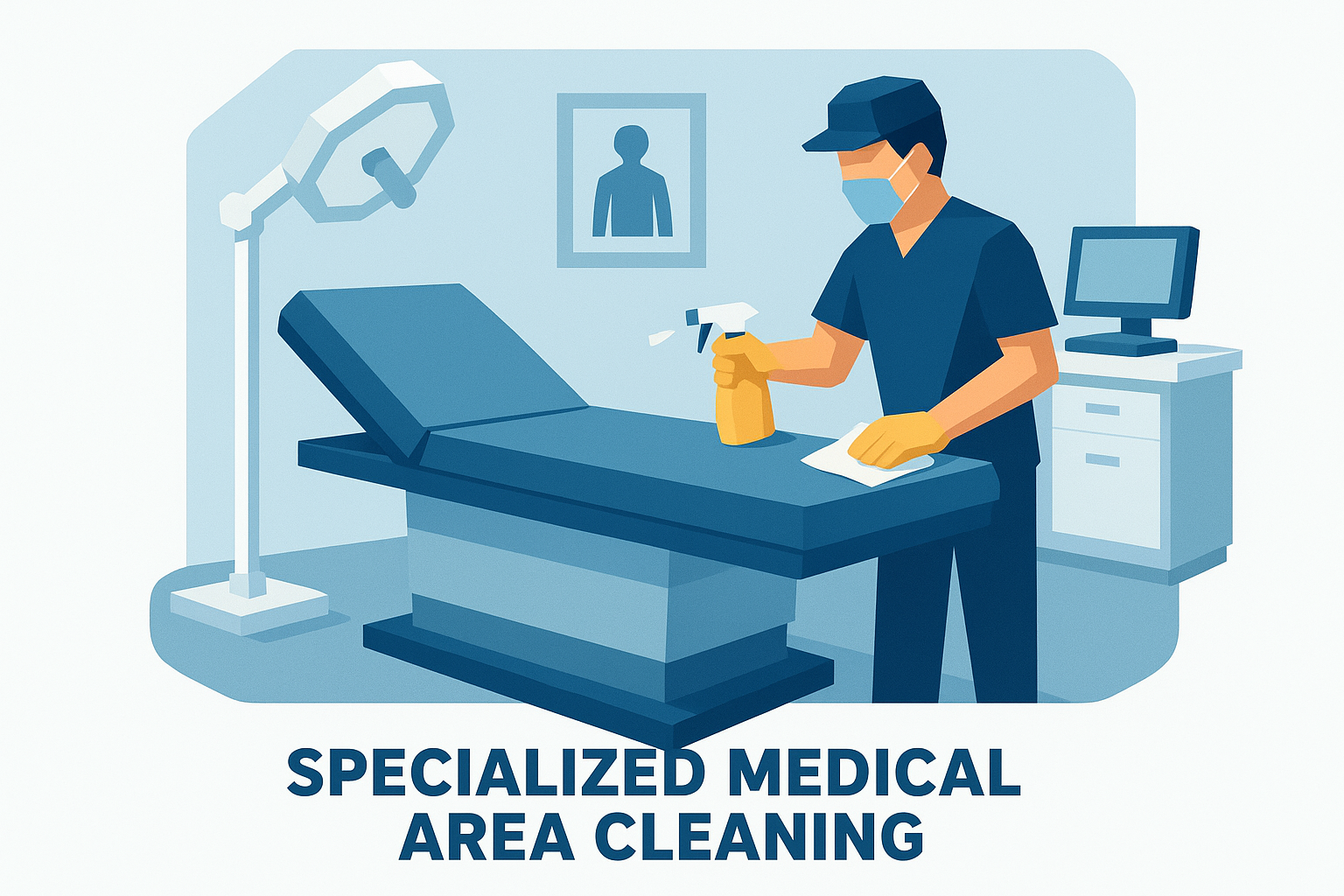
Professional medical cleaners follow documented protocols that ensure consistent disinfection standards across all patient care areas, reducing infection transmission risks.
Biohazard and waste management
Your cleaning service handles sharps containers, biohazard waste, and regulated medical waste according to OSHA standards and local regulations. They use proper personal protective equipment when removing contaminated materials and follow specific procedures for spill cleanup involving blood or bodily fluids. Cleaners separate regular waste from regulated medical waste, ensuring proper containment and documentation. They also manage pharmaceutical waste containers and coordinate with licensed medical waste disposal companies for compliant pickup and destruction. This service protects your staff from exposure risks and maintains your regulatory compliance.
Deep cleaning and periodic services
Beyond daily maintenance, your provider should offer scheduled deep cleaning services that address areas requiring less frequent attention. These services include floor stripping and waxing, carpet extraction cleaning, upholstery deep cleaning, and high-dusting of vents, light fixtures, and ceiling areas. Window cleaning, both interior and exterior, maintains professional appearance and natural light quality. Some providers offer specialized services like power washing exterior walkways, parking areas, and building facades. Quarterly or semi-annual deep cleaning of storage areas, break rooms, and administrative spaces ensures comprehensive facility maintenance. Your cleaning contract should specify the frequency of these periodic services based on your facility size and patient volume.
What medical office cleaning services cost
Medical office cleaning services typically cost $200 to $600 per visit for small to mid-sized practices, with monthly contracts ranging from $1,000 to $4,000 depending on your facility size and service frequency. These prices exceed standard commercial cleaning rates because medical facilities require specialized training, healthcare-grade disinfectants, and compliance documentation. Your actual costs depend on multiple factors including square footage, service frequency, staff size, and the complexity of your medical specialty.
Pricing models and contract structures
Most providers offer flat-rate monthly contracts based on your facility size and cleaning frequency, giving you predictable budgeting without surprise charges. You pay a set fee regardless of minor variations in cleaning time or supply costs. Some companies use per-square-foot pricing, typically ranging from $0.10 to $0.25 per square foot for medical facilities, which scales directly with your office size. Hourly billing occasionally applies for emergency cleaning or specialized services, averaging $35 to $75 per hour depending on your location and the required expertise level. Long-term contracts (six months or longer) often secure lower rates compared to month-to-month agreements.
Factors that affect your cleaning costs
Your facility's square footage represents the primary cost driver, with larger practices requiring more cleaning time and supplies. Service frequency directly impacts pricing, as daily cleaning costs more than weekly visits, though daily service often provides better per-visit rates through volume discounts. Medical specialty affects costs significantly because surgical centers need more intensive protocols than general family practices, and dental offices require specialized equipment cleaning that standard medical offices don't. Your patient volume and operating hours also matter, as high-traffic facilities accumulate more dirt and require more frequent restocking. Additional services like floor waxing, window cleaning, or biohazard waste removal add separate charges ranging from $50 to $300 per service depending on complexity.
Higher-risk medical specialties requiring intensive disinfection protocols naturally cost more than basic examination facilities, but this investment protects your patients and regulatory standing.
Geographic location influences pricing substantially, with major metropolitan areas charging 20% to 40% more than rural regions due to higher labor costs and operational expenses. You can reduce costs by bundling services, signing longer contracts, or adjusting service frequency for low-traffic areas. However, cutting corners on medical office cleaning services compromises patient safety and regulatory compliance, making cost your secondary consideration after quality and healthcare expertise.
Questions to ask medical cleaning providers
Asking the right questions during your vetting process reveals whether a provider truly understands healthcare environments or just claims they do. Your conversation should cover compliance expertise, service delivery details, and emergency response capabilities. These questions help you distinguish between standard commercial cleaners who dabble in medical facilities and true healthcare cleaning specialists. You want specific answers backed by documentation rather than vague assurances.
Essential questions about credentials
Ask potential providers to show their healthcare-specific certifications and explain what training their staff completes before entering medical environments. Request proof of current insurance coverage and verify they carry adequate liability limits for healthcare facilities. You need confirmation they understand OSHA bloodborne pathogen standards and can provide written protocols for handling biohazard spills or infectious disease exposures. Ask how they document their cleaning procedures and whether their records support your facility during regulatory inspections or compliance audits.
Service delivery questions
Confirm whether they assign dedicated cleaning teams to your facility or rotate staff across multiple clients. You want to know their availability for emergency cleaning situations and how quickly they respond when urgent needs arise. Ask about their quality control processes and whether they conduct regular inspections of their work. Find out what happens if you're unsatisfied with their service and how they handle complaints or service failures.
Providers who answer your questions with specific protocols and documentation demonstrate their healthcare expertise, while vague responses signal insufficient experience.
Request references from similar medical office cleaning services they currently maintain, then actually contact those references to verify service quality. Ask what products they use, whether they're EPA-registered for healthcare settings, and if they offer eco-friendly alternatives that still meet disinfection standards.
Next steps
Finding qualified medical office cleaning services protects your patients, satisfies regulatory requirements, and maintains your professional reputation. You now understand what services to expect, how much they cost, and which questions separate experienced healthcare cleaners from standard commercial providers. Your next move involves contacting providers who demonstrate healthcare expertise, requesting detailed proposals, and checking references from similar medical facilities.
Start by evaluating your current cleaning protocols and identifying gaps in compliance or service quality. Document your specific needs including square footage, patient volume, and specialty requirements. Contact at least three providers who specialize in medical environments to compare services, pricing, and credentials.
Pure Productive Services offers comprehensive medical office cleaning services in Philadelphia and surrounding areas, with certified, bonded, and insured staff trained in healthcare protocols. Request a consultation to discuss your facility's specific needs and receive a customized cleaning plan that maintains compliance while fitting your budget.

